For grade 5-12 teachers

Cranium CoRE for teachers: a game show built from the book you're already teaching

You do not need another program. You need the thirty students in front of you to read chapter six, care what happens in it, and be able to tell you why with the book open. Cranium CoRE is a reading comprehension game for grades 5-12 that does that in one class period, on the novel, article, or textbook chapter you already assigned, with setup that takes less time than passing out a worksheet.

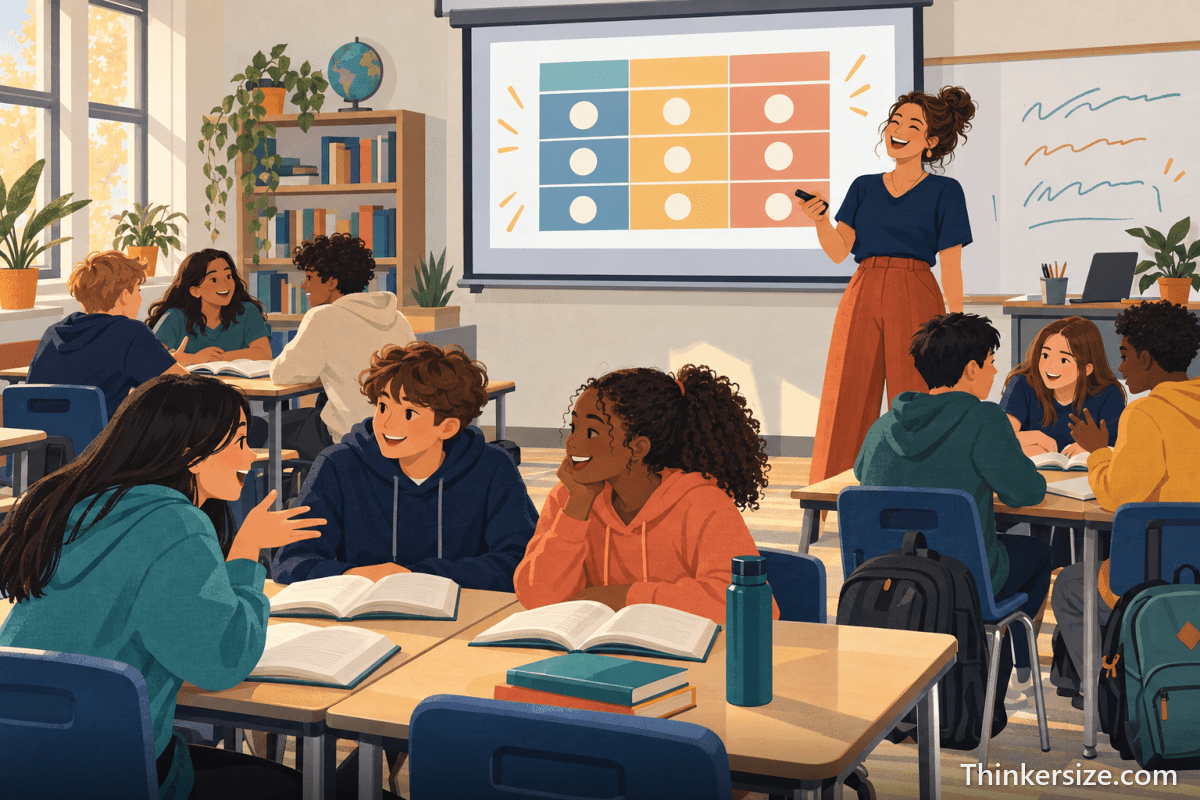
A teacher hosts a Cranium CoRE game while teams of three students confer over open books.

One class period with Cranium CoRE

Minutes 0-15

Read aloud, read along

You read the chapter aloud or a student does. Everyone follows in the text. Your below-level readers hear the chapter at a comprehension level two years above where they read alone, so the game is fair before it starts.

Minutes 15-35

Play

Teams of three, one device each, questions on your projector. Each question gets a minute and three attempts; points fall with each attempt; being first earns nothing. The questions are inference, author's purpose, compare and contrast, sequencing, and argument - not "what color was the hatchet."

Minutes 35-50

Discuss and defend

Hit the Game Alert. Teams explain their answer from the text while the others challenge it. This is the accountable-talk routine you have been trying to build, except the students asked for it because there is a score on the board.

Homework, if you want it

Write the next round

Each team writes three higher-order questions on the next chapter. You play them tomorrow.
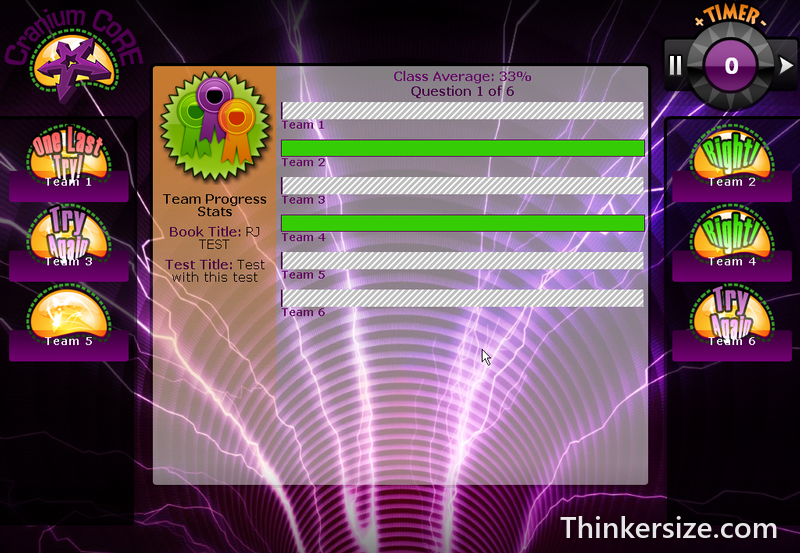
Cranium CoRE team progress screen with a bar for each team and the class average.
Cranium CoRE screen: team progress.

See where every team stands

Between questions the progress screen shows a bar for each team next to the class average, so every team can see where it stands before the next question goes up - and you can see which teams need you at their table.


What it does for your classroom

Reluctant readers read

Teams depend on each other, so students read ahead rather than let teammates down. Teachers tell us about students who finished a book for the first time to play.

Text evidence becomes a reflex

Every answer has to be defended from the page. After a few rounds, "where does it say that?" is something students ask each other.

Discussion with no cold-calling

The team already agreed on an answer; defending it is low stakes and high engagement.

Formative insight without a grade book

You hear exactly which inferences a team can and cannot make. It is observational by design - Cranium CoRE is not an individual assessment tool, and students know it, which is why they talk.

Writing that students volunteer for

Question authoring is the easiest writing task you will ever assign, and the best mastery check.

Works across subjects

ELA, social studies, science - any class with a text. The library includes curriculum games, and you can write your own on anything.

Writing questions that are worth arguing about

Cranium CoRE questions live at the top of Bloom's and Webb's Depth of Knowledge levels 3 and 4. A built-in tutorial walks you and your students through the process Andy teaches on-site in his full-day Textually Complex Question Writing training:

  1. Start from a decision, change, or claim in the chapter, not a fact.
  2. Ask what the author wants the reader to conclude, and where the text earns it.
  3. Require two pieces of evidence, or a comparison across two moments.
  4. Write a distractor that a careless reader would pick.
  5. Play it. If no team argues, rewrite it.

Professional development for your school or district

A high school student drafts higher-order questions for the next Cranium CoRE game.

Mapped to the frameworks you are evaluated on

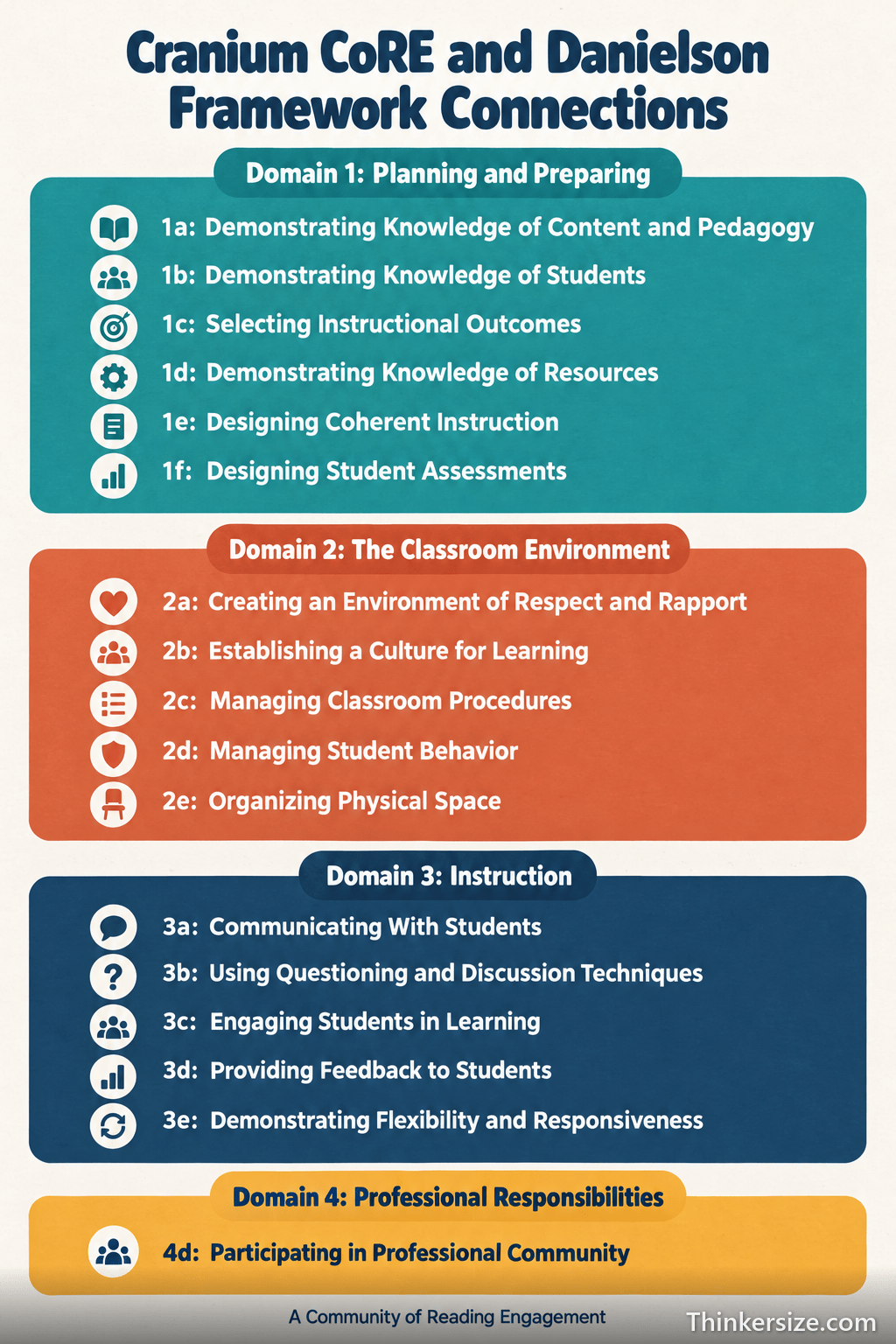
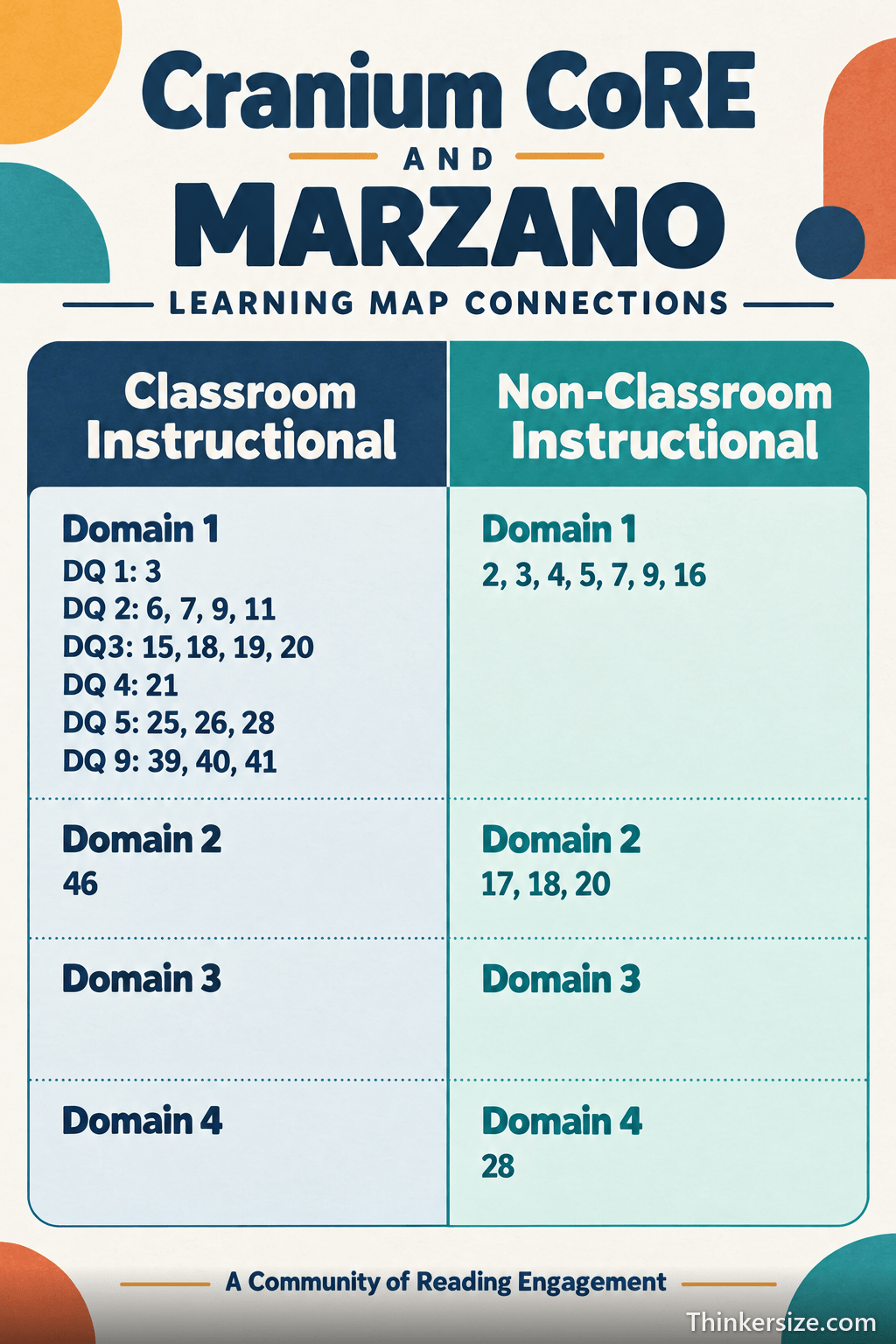
If your evaluation runs on Charlotte Danielson's Framework for Teaching or on Robert Marzano's learning map, a Cranium CoRE class period is evidence for both. The read-aloud, the team game, the discuss-and-defend step, and student question writing touch planning, classroom environment, questioning and discussion, engagement, and feedback in a single lesson.

Infographic: Cranium CoRE and Danielson framework connections, listing the components of Domain 1 Planning and Preparing, Domain 2 The Classroom Environment, Domain 3 Instruction, and Domain 4 component 4d that a Cranium CoRE lesson supports.
Cranium CoRE and the Danielson Framework for Teaching: framework connections.
Text version

Cranium CoRE and Danielson - Framework Connections

Domain 1: Planning and Preparing

  • 1a: Demonstrating Knowledge of Content and Pedagogy
  • 1b: Demonstrating Knowledge of Students
  • 1c: Selecting Instructional Outcomes
  • 1d: Demonstrating Knowledge of Resources
  • 1e: Designing Coherent Instruction
  • 1f: Designing Student Assessments

Domain 2: The Classroom Environment

  • 2a: Creating an Environment of Respect and Rapport
  • 2b: Establishing a Culture for Learning
  • 2c: Managing Classroom Procedures
  • 2d: Managing Student Behavior
  • 2e: Organizing Physical Space

Domain 3: Instruction

  • 3a: Communicating With Students
  • 3b: Using Questioning and Discussion Techniques
  • 3c: Engaging Students in Learning
  • 3d: Providing Feedback to Students
  • 3e: Demonstrating Flexibility and Responsiveness

Domain 4: Professional Responsibilities

  • 4d: Participating in Professional Community

A Community of Reading Engagement

Infographic: Cranium CoRE and Marzano learning map connections, listing the classroom instructional and non-classroom instructional domain elements that Cranium CoRE supports.
Cranium CoRE and the Marzano learning map: element connections.
Text version

Cranium CoRE and Marzano - Learning Map Connections

Classroom Instructional

  • Domain 1 - DQ 1: 3
  • Domain 1 - DQ 2: 6, 7, 9, 11
  • Domain 1 - DQ 3: 15, 18, 19, 20
  • Domain 1 - DQ 4: 21
  • Domain 1 - DQ 5: 25, 26, 28
  • Domain 1 - DQ 9: 39, 40, 41
  • Domain 2: 46

Non-Classroom Instructional

  • Domain 1: 2, 3, 4, 5, 7, 9, 16
  • Domain 2: 17, 18, 20
  • Domain 4: 28

A Community of Reading Engagement

Setup and devices

One classroom computer on a projector, Chrome or any modern browser, strong Wi-Fi, and one device per team: a phone or tablet with the free Cranium CoRE Remote app, or any laptop or Chromebook in a browser. Students do not log in. Most teachers run their first game within 15 minutes of creating an account.

Download on the App StoreGet it on Google Play

No student devices? Keyboard mode

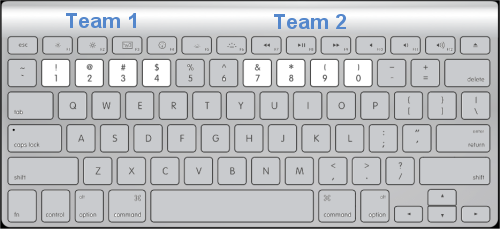
With remote play turned off, two teams can play on the host computer: Team 1 answers with the 1, 2, 3, 4 keys and Team 2 with 7, 8, 9, 0. For a full class of ten teams, each team needs one phone, tablet, or Chromebook.

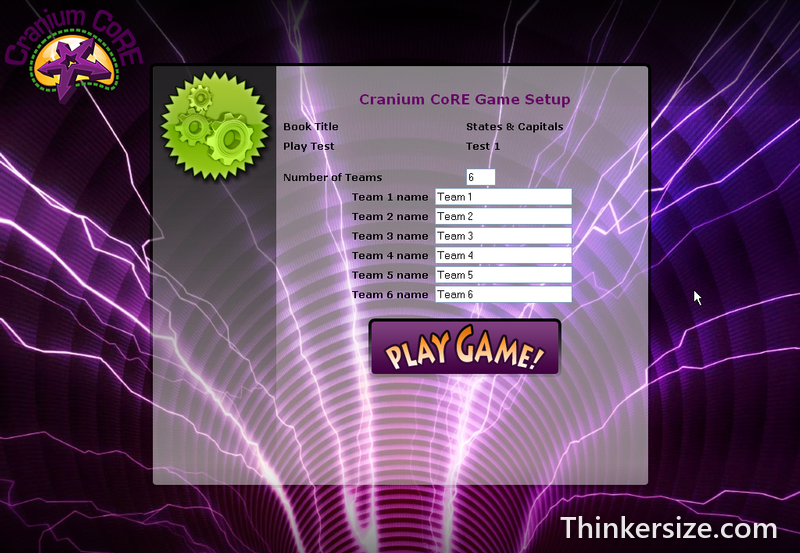
Cranium CoRE game setup screen where the host names the teams and starts play.
Cranium CoRE screen: game setup, where you name the teams and start play.
Keyboard mode: on the host keyboard, Team 1 answers with keys 1 to 4 and Team 2 with keys 7 to 0.
Keyboard mode: Team 1 uses keys 1-4, Team 2 uses keys 7-0.

Free account, then your school's license

Create a free account on craniumcore.com and play 1-2 player games on the keyboard to see the questions and the flow. When you are ready for full team play, your school buys one annual license - every teacher and librarian in the building gets an account under it - and you unlock unlimited plays, ten-team games, create-your-own games, and community sharing. If your school already has a license, ask your site administrator for a sub-account.

Cranium CoRE vs the reading log

QuestionTraditional reading logCranium CoRE
What you learnMinutes and page countsWhich inferences a team can defend
Can it be fakedEasilyNot with the book open and a team watching
Higher-order thinkingNone requiredRequired to score
Your workloadCollect, verify, interpretPick the chapter, press play, listen

Literacy strategy glossary

Textual evidence
Specific passages or details cited to justify a claim about a text.
Inference
A conclusion drawn from textual clues plus prior knowledge; goes beyond what is stated.
Higher-order question
A prompt requiring analysis, synthesis, evaluation, or application rather than recall.
Metacognition
Awareness and regulation of one's own thinking while reading and discussing.
Accountable talk
Structured dialogue norms ensuring claims are supported and peers' ideas are referenced respectfully.
Formative assessment
Ongoing evidence collected during learning to inform immediate instructional adjustments.
Text complexity
Quantitative, qualitative, and reader-task considerations that determine challenge level.
Comprehension
Construction of meaning from text, integrating decoding, vocabulary, background knowledge, and reasoning.

Frequently asked questions

How much prep does a game take?

If the book is in the library, none beyond choosing the chapter. If you are writing your own, budget about as long as writing a good exit ticket - and let students write the next one.

Can I grade it?

We would not. Cranium CoRE is observational. Use what you hear in discuss-and-defend to plan tomorrow, not to fill a grade book.

Does it work for a 50-minute period?

Yes. Read aloud, play, and defend fit in one period for a typical chapter. Longer chapters work as two rounds on two days.

What about students who hate competition?

The team layer helps: nobody answers alone, and the points reward being right, not fast. Teachers report that the students who dislike quiz apps are often the ones who thrive here.

Can I pause a game?

Yes. The host can pause the game at any time - to settle a disputed answer, to send teams back to the text, or to run the discuss-and-defend step before the next question.

Do teams get the same points no matter how many attempts they use?

No. Each team gets up to three attempts per question, and the point value drops with each attempt. Being first earns nothing; the question rewards being right, which is why teams talk before they tap.

Is there help for writing higher-level thinking questions?

Yes. The built-in question-writing tutorial walks you and your students through the process with examples, and the same process is the backbone of Andy's full-day Textually Complex Question Writing training, which he offers on-site for schools and districts.

Can we play without student devices?

Yes, for up to two teams. With remote play turned off, Team 1 answers with the 1, 2, 3, 4 keys on the host computer and Team 2 with 7, 8, 9, 0. For a full class of ten teams, each team needs one phone, tablet, or Chromebook.

See it with your students