For district literacy leaders

Cranium CoRE for school districts: one literacy routine, every school

A district literacy plan for grades 5-12 lives or dies on whether the routine actually happens in the classroom. Cranium CoRE is a routine teachers run because students ask for it: read a chapter aloud, play a team game show of higher-order questions, defend every answer from the text, write the next round. Licensed per school, aligned to the frameworks your evaluators already use, with no student personal data for your technology office to vet, it is the rare literacy platform that a middle school, a high school, and a media center can all run the same way.

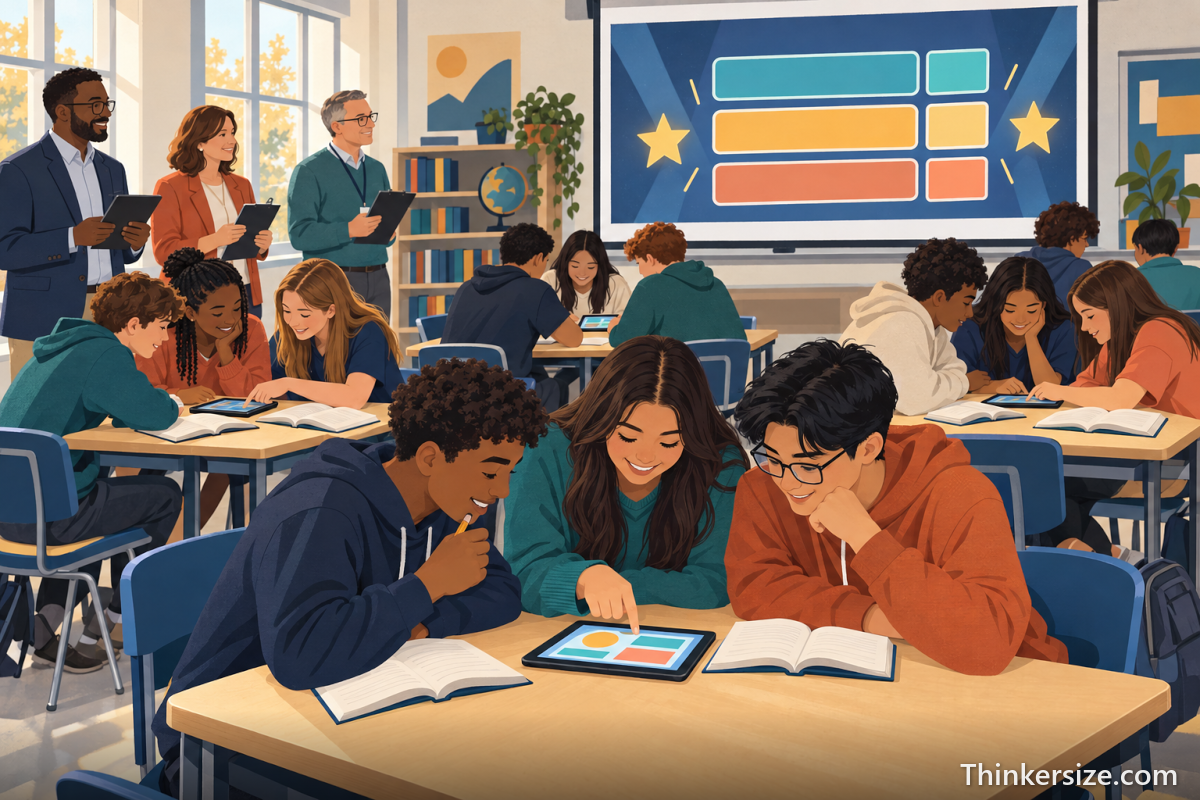
District leaders observe a Cranium CoRE team game in a grade 9 classroom.

What a district gets

The same routine in every building

One method, one vocabulary (text evidence, discuss and defend, higher-order questions), from grade 5 through grade 12, across ELA, social studies, and science.

Unlimited staff accounts per licensed school

Every teacher, librarian, coach, and administrator in the building gets a sub-account under the school license.

A shared library

Games written in one school publish immediately and can be shared across the district, so a single question set for this year's Battle of the Books list serves every school.

District-wide Battle of the Books

Two schools at the same grade play the same game: one school hosts the game show and screenshares it over a video call, and the team at the other school watches the screenshare and answers on its own device. Championship rounds run from any media center.

Professional development that outlasts the license

Andy Larson's full-day Textually Complex Question Writing training gives teachers a repeatable process for writing questions that measure understanding of complex text, in any subject.

A vendor who shows up

Andy runs games in classrooms across the United States. A pilot starts with him in your building, with your students, on a book they are reading now.


Teachers draft higher-order questions during Cranium CoRE question-writing training.

Standards alignment

Cranium CoRE's method is mapped to the documents districts are evaluated on:

  • State ELA standards, grades 5-12. Reading Literature (key ideas and details, craft and structure, integration of knowledge), Reading Informational Text, Writing (argument and informative questioning), and Speaking and Listening (collaborative discussion, evidence citation and reasoning). Per-grade alignment documents are published for grades 5 through 8 and for the 9-10 and 11-12 bands, and also reference the AASL Standards for the 21st-Century Learner.
  • Marzano. An alignment document covers all 41 elements of Domain I, Classroom Strategies and Behaviors, and maps each to a Cranium CoRE method - built for teachers evaluated on the Marzano rubric.
  • Danielson. A companion document aligns the method to the Framework for Teaching.
  • Webb's Depth of Knowledge and Bloom's Taxonomy. Question types are written to DOK 3-4 and the analysis, evaluation, and creation tiers.

See the Danielson and Marzano infographics, with text versions, on the teachers page, Webb's DOK on the Cranium CoRE page, and Bloom's on the librarians page.

Alignment documents on craniumcore.com

MTSS and RtI fit

Cranium CoRE is not a screener and not a progress-monitoring instrument, and we will not pretend otherwise. It is a Tier 1 engagement routine that also works in Tier 2 small groups: three students, one device, one chapter, questions that require inference, and a discussion where the teacher hears exactly which inferences each team can and cannot defend. Media specialists use it with students identified as at risk because it holds the attention of readers who have tuned out everything else, and because it gives those students a reason to read ahead - their team is counting on them. Pair it with your existing universal screening and let it do the part your data says is missing: time on text, out loud, with evidence.

Evidence and outcomes

Cranium CoRE's process rests on research-based practices with decades of support: read-aloud, cooperative learning, higher-order questioning, and structured academic discussion.

  • Read-aloud. Listening comprehension runs roughly two years ahead of independent reading level, so the whole class works from the same text.
  • Cooperative learning. Teams of three on one device have to talk before they answer.
  • Higher-order questioning. Questions are written to DOK 3-4, never just recall.
  • Structured academic discussion. Every answer is defended from the text in the discuss-and-defend step.

Student privacy and procurement

No student personal information

Students do not log in, create accounts, or enter a name, email, or age. A team enters a team name. Cranium CoRE collects no personal information from children.

Session cookies only

No permanent cookies, no advertising, no sale or commercial sharing of data. Designed around FERPA principles.

Staff data is minimal

Teacher accounts hold a name, school, and email.

Nothing to install

100% browser based (Chrome 85+, Edge 85+, Firefox 80+, Safari 12+). Students can play directly at remote.craniumcore.com in the Chrome browser, or on district-managed iOS 12+ and Android 7+ devices with the free Cranium CoRE Remote app from the App Store or Google Play.

Purchase orders welcome

Order by credit card or send a purchase order; premium access is normally live within 48 hours.

Pricing for districts

Cranium CoRE is licensed per school, per year, with unlimited staff accounts for every licensed building. On its own, a school pays by enrollment tier. A district that licenses every one of its schools pays the lowest tier for all of them.

District rate: $349 per school, per year, for every school in the district.

When a district licenses all of its schools, each building - the 400-student middle school and the 2,400-student high school alike - is priced at the lowest enrollment tier. A district with eight schools pays 8 x $349 = $2,792 per year, and every teacher and librarian in all eight buildings gets an account.

Single-school pricing, for comparison
School enrollmentSingle school, per yearEvery school in the district, per year
Up to 499 students$349$349
500 to 999 students$399$349
1,000 to 1,499 students$449$349
1,500 to 1,999 students$499$349
2,000 or more students$549$349

What premium includes

  • Unlimited game plays and team play for up to ten teams per game
  • Support for Side Keys RF transmitters (handheld clickers); free accounts do not support Side Keys
  • Sub-accounts for every teacher, librarian, coach, and administrator in each licensed school
  • Create-your-own games on any text, published immediately and shareable across the district
  • Community participation: comment on, rate, and share games with other member schools
  • New games on popular literature from staff and the community, and online training and best practices - included at every level
  • No student accounts and no student data at any level

A free non-student account lets anyone demo the product with up to 25 games first. The full free vs premium table is on the Cranium CoRE page.

Purchase options

Order by credit card on craniumcore.com or by purchase order: create a free account, print the order form, and send it with your PO. Premium access is normally live in under 48 hours. For a multi-school order, request a single district quote and tell us how many buildings; professional development can be bundled with the rollout.

A 90-day rollout

  1. Weeks 1-2: pilot

    Andy runs games in two or three classrooms and the media center on books students are reading now. Teachers watch the discuss-and-defend round and decide for themselves.

  2. Weeks 3-4: license and train

    Schools license, every staff member gets a sub-account, and the question-writing training runs for ELA and content-area leads.

  3. Weeks 5-10: routine

    Each school runs Cranium CoRE at least weekly in grades 5-12. Teachers and students write games on district texts and share them.

  4. Weeks 11-13: district battle

    Schools compete at the same grade. The hosting media center runs the game show and screenshares it over a video call; the team at the other school watches the screenshare and answers on its own device.

A district championship Battle of the Books round on Cranium CoRE, with a second school watching the host school's screenshare.
One school hosts the game screen while a team at another school joins by video call.
School versus school: the host school screenshares the game show, and the other school's team answers on its own device.

Frequently asked questions

Is pricing per student?

No. Per school, per year, unlimited staff accounts. The only variable is each school's total enrollment.

Does it integrate with our SIS or LMS?

It does not need to. Students never log in, so there is no roster to sync. Teachers sign in with an email address.

Which standards documents can we hand to our board?

Per-grade ELA alignment documents for grades 5-12, the Marzano Domain I alignment covering all 41 elements, the Danielson Framework alignment, and the Webb's DOK and Bloom's infographics.

Can one school's games be used in another?

Yes. Premium members publish games immediately and can share them across member schools.

Who runs the training?

Andy Larson, Co-Founder and President, in person or over video. His full-day Textually Complex Question Writing training has run for districts, BOCES, colleges of education, and media specialist groups.

Is there district pricing?

Yes. A district that licenses every school pays the lowest enrollment tier, $349 per school per year, for every building regardless of its enrollment. Each school still gets its own license with unlimited staff accounts.

How do we order?

By credit card on craniumcore.com, or by purchase order: create a free account, print the order form, and send it with your PO. Premium access is normally live in under 48 hours. For a multi-school order, request a single quote through the contact page.

Can Cranium CoRE be used as an assessment?

Observationally, yes; formally, no. It is not a screener or a progress-monitoring instrument. Its purpose is to drive thematic discussion of the text so comprehension improves, and what teachers hear in the discuss-and-defend step is excellent formative evidence. Keep your universal screener.

What does district IT need to install or open?

Nothing to install. Cranium CoRE runs entirely in a browser and needs only an internet connection; the host computer uses Chrome, Edge, Firefox, or Safari, and teams use the free Cranium CoRE Remote app on managed iOS or Android devices or any Chromebook browser.