Ready, set, go: the battle is the show



Every Cranium CoRE round opens with the same Ready, Set, Go! countdown on the big screen, and then two teams of three go head to head on the book they both read.
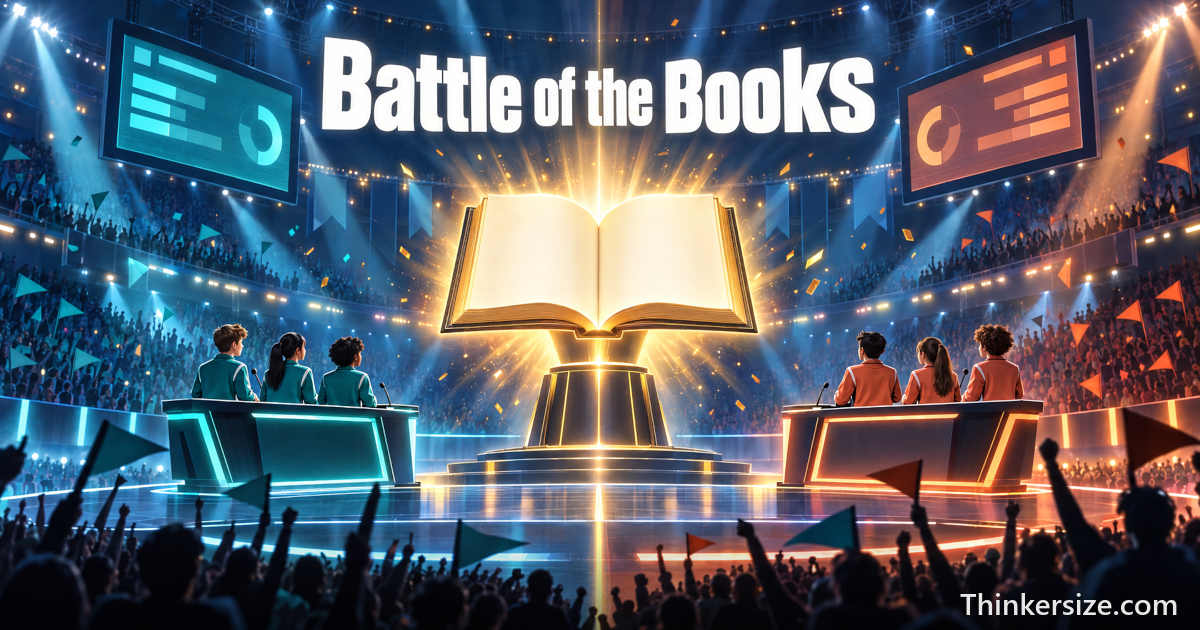
Battle of the Books on Cranium CoRE
Battle of the Books is the best thing that happens in a school library all year, and most of the software used to run it is a trivia engine. Cranium CoRE is Battle of the Books software built by people who host battles: teams of three, one device per team, one minute and three attempts per question, points for being right instead of being first, and a discuss-and-defend step where the winning team has to show the page. Schools use it for practice all season and for the school-versus-school battle at the end, with every team competing at the same grade.
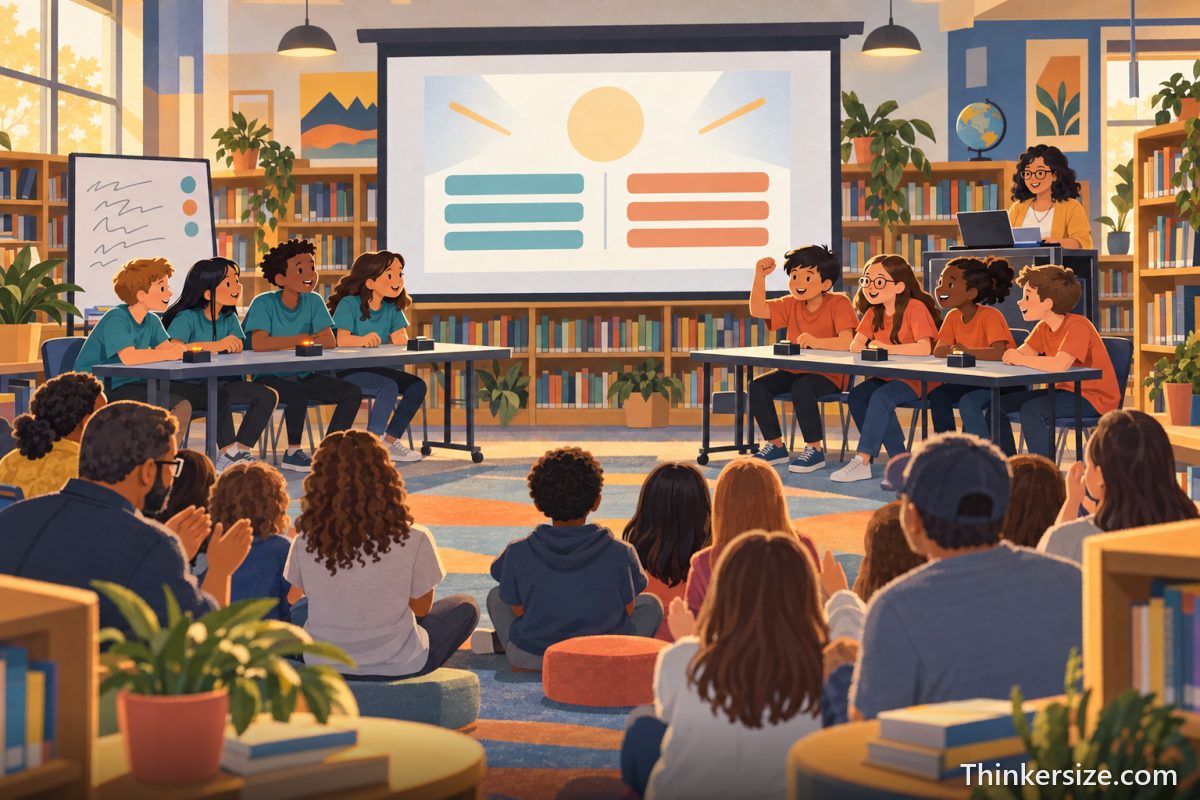
Every Cranium CoRE round opens with the same Ready, Set, Go! countdown on the big screen, and then two teams of three go head to head on the book they both read.
If you are new to it: Battle of the Books is a voluntary reading competition for students in roughly grades 3-12. America's Battle of the Books, run by volunteer educators and librarians, publishes the national model, and dozens of state and regional programs run their own versions - Florida's county battles built on the Sunshine State Young Reader Award list, Illinois' Caudill Challenge for grades 6-8, Oregon Battle of the Books, North Carolina's Elementary and Middle School Battle of the Books, and hundreds of library-run battles.
The common shape:
It works. Kids read books they would never have picked up. But the "In which book" format has a ceiling: it tests whether you remember which book had the spider, not whether you understood why the spider mattered. And the practice tools most programs reach for - flash-card sets, Kahoot, Nearpod, Moodle quizzes - are built to reward recall and reaction time.
Cranium CoRE keeps everything librarians love about Battle of the Books and changes the part that matters.
Up to ten teams play at once, each on one shared device. Three per team is ideal: small enough to decide in a minute, odd enough that nobody ties. A team cannot answer until it has talked.
Questions are written to the higher-order end of Bloom's: inference, author's purpose, compare and contrast, sequencing, persuasive argument. "In which book" questions are welcome, but the battle is won on questions like "What does the author want you to believe about the father by the end of chapter nine, and which two moments prove it?"
Every team gets the full time limit and up to three attempts. Points decrease with each attempt. The first team to lock in gets nothing extra. Andy tells every room he hosts the same thing: the thoughtful answer earns the most points.
After the round, the Game Alert opens the floor. Teams defend their answer from the text, out loud, with the book open. In a battle this is where the crowd leans in, and it is the step no trivia app has.
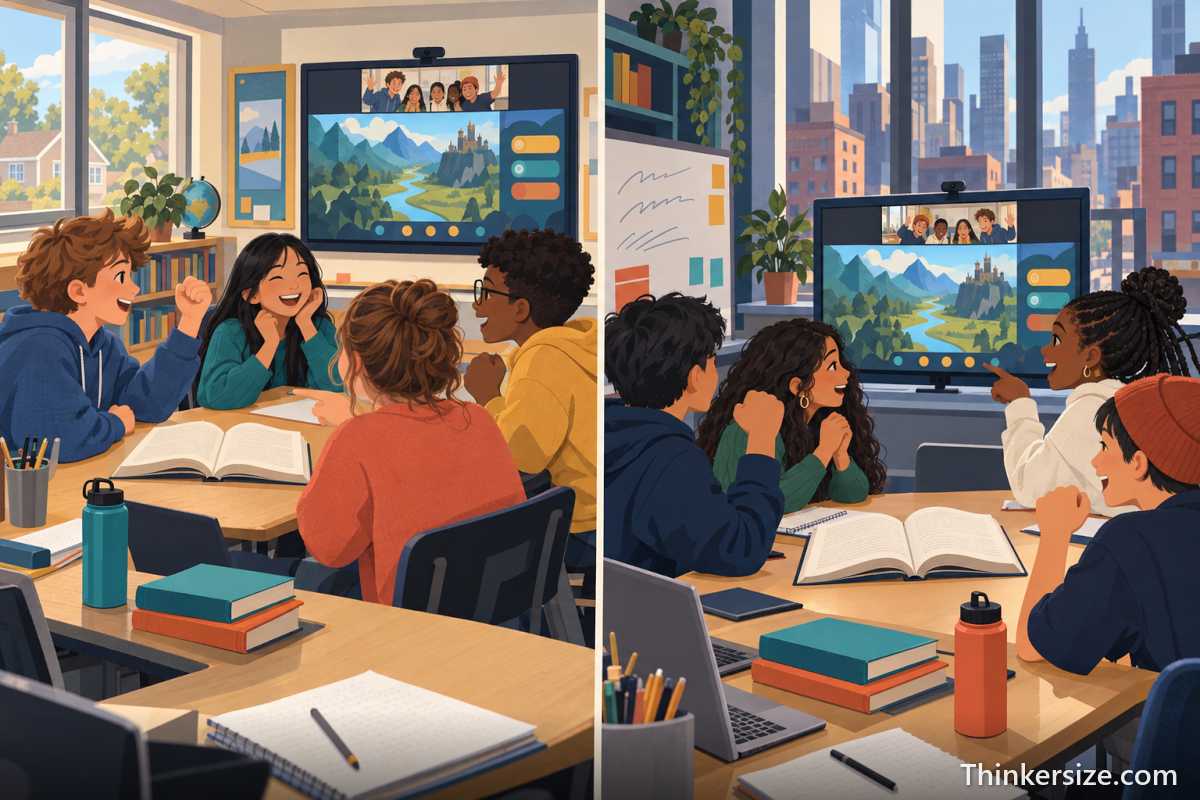
Battles run inside one building or between schools. Two schools at the same grade play the same Cranium CoRE game: one school hosts the game show and screenshares it over a video call, one team plays in the room where the game show is, and the team at the other school watches the screenshare and answers on its own device. In January 2013, Hannah Beardsley Middle School in Crystal Lake, Illinois played Evergreen Academy of the Chicago Public Schools on Paul Griffin's Orange Houses - two schools fifty miles and a world apart, one book, one game. Districts use the same setup for their championship round.
The Cranium CoRE library already holds community-built Battle of the Books sets alongside 7,000+ games on 1,875 books, and premium members write their own games on this year's titles and publish them to their school immediately. Write a set for the Focus Five, share it across the district, and every school practices on the same questions.

Read the first list title aloud in the library or in class, play the existing game, run the discuss-and-defend. Students learn the format in one session.
Assign each team a title. Teams write higher-order questions with the built-in tutorial, then play each other's games. Students who write questions read the book twice without being asked.
Run full ten-team rounds with the time limit on. Rotate team members so nobody is carrying a team alone. Invite a feeder school or a neighbor school to a scrimmage: you host the game show and screenshare it, and their team answers from its own device.
Same grade, same game, in one room or screenshared to a team at another school. Project the board in the cafeteria or the media center, put the trophy where everyone can see it, and let the discuss-and-defend round decide the close ones.
Florida county programs have run their Battle of the Books as a Cranium CoRE game for years, building each season on the Sunshine State Young Reader Award list and describing the game to families as one "designed to encourage our readers to delve into the text to support the answers to quiz bowl type questions." Andy Larson has hosted battles in person, reads the list every year, and writes the questions himself. Middle school programs use community-built sets like the Guys Read Middle School final battle, and the library holds grade-specific Battle of the Books games built by member schools.
| Feature | Cranium CoRE | Quiz apps (Kahoot, Nearpod, Crowdpurr) | Flash-card sets (Quizlet) | Paper battle |
|---|---|---|---|---|
| Question depth | Higher-order, text-dependent | Recall, multiple choice | Recall, title and author | Recall, "In which book" |
| Play unit | Team of three, one device | One student per device | Individual | Team, buzzer or hand |
| Scoring | Right beats fast; points fall per attempt | Fastest correct answer wins | n/a | First hand up |
| Defend the answer | Built in (Game Alert) | No | No | Rarely |
| Student accounts | None - team name only | Usually required | Required | None |
| Students write questions | Yes, with tutorial | Teacher only | Teacher only | Sometimes, on paper |
| School vs school | Yes, same grade, by screenshare | Possible, no team layer | No | In person only |
| Content on this year's list | Library sets plus create your own | Build from scratch | Buy per title | Volunteer-written |
Yes. Teams at two different schools, at the same grade, play the same game. One school hosts the game show and screenshares it over a video call; one team plays where the game show is, and the team at the other school watches the screenshare and answers on its own device. Districts use it for their championship round; neighboring schools use it for scrimmages.
No. Use the community-built Battle of the Books sets, or write your own on this year's list. Premium members publish games immediately and can share them with every school in the district.
Yes. Cranium CoRE is not tied to any list. Florida programs use the SSYRA titles; you use yours. If a title is not in the library yet, your students can be the first to write it.
Up to ten teams per game. With teams of three, that is a full class of thirty, or ten school teams in a district final.
Nothing personal. No login, no account, no email. One phone, tablet, or Chromebook per team running the free Cranium CoRE Remote app or a browser, and a copy of the book.
Yes. Andy is available to be the game show host for your battle, in person or over video. Ask on the contact page.
No. Every team gets the full time limit and up to three attempts. A fast team cannot shut out a careful one, which is the point of running a battle on Cranium CoRE instead of on a buzzer.
A correct answer scores, and the value drops with each attempt the team used. Speed earns nothing. The thoughtful answer earns the most points.
Yes, at any time: for a disputed answer, for the discuss-and-defend round, or because the crowd needs a minute.
Because the collaboration is the skill. It is as simple as real life: three readers have to agree on one answer in a minute, and that means persuading, listening, and settling a disagreement with the book open. Three is small enough to decide quickly and odd enough to break a tie.
See a full round with your own students on a title from your list.